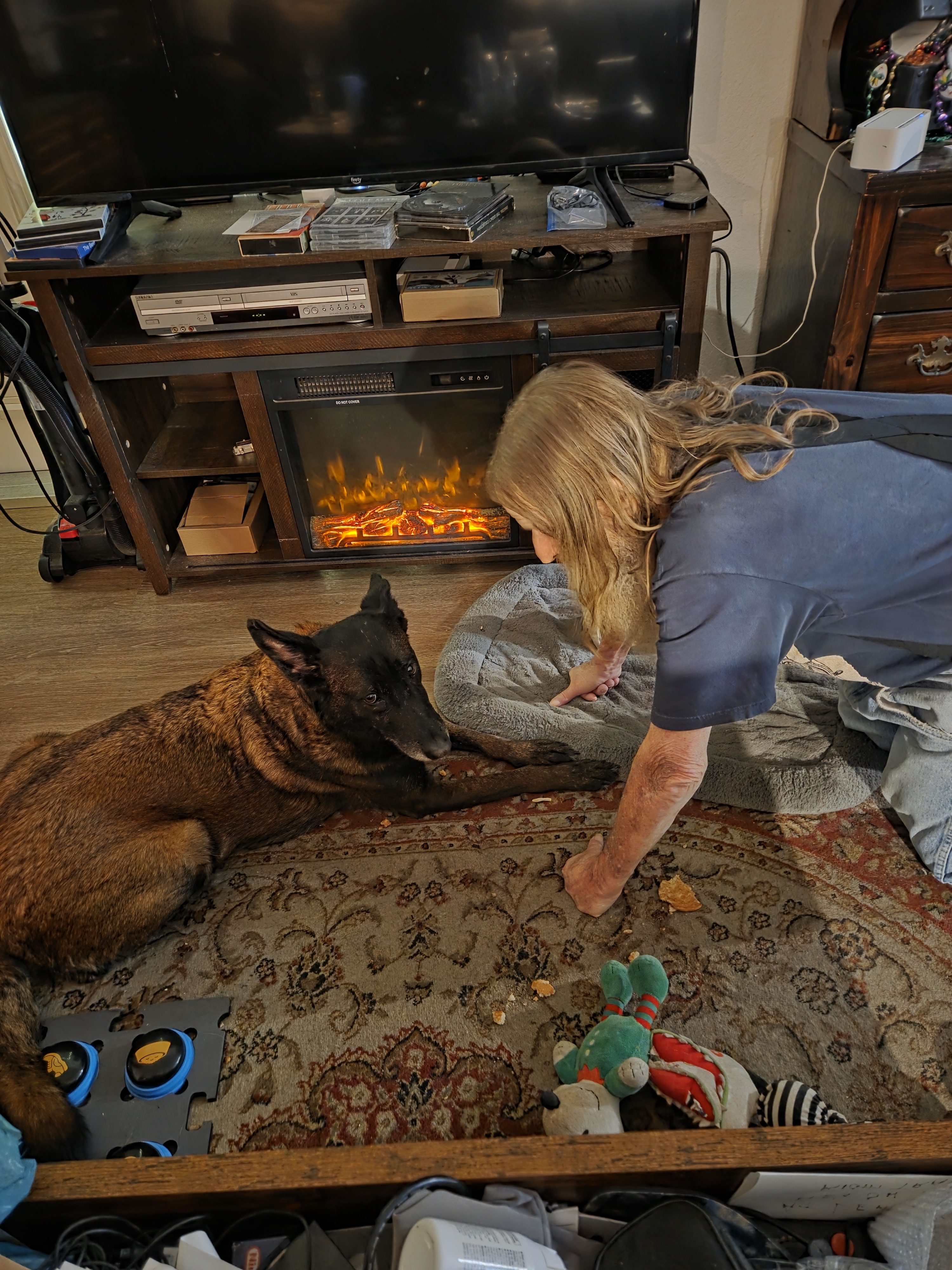
Does my dog understand me?
It’s a question I hear all the time. And one a new peer-reviewed study just put language to in a way many service dog handlers already recognize, but struggle to explain.
Dogs aren’t just performing trained tasks.
They’re interpreting human needs in real time.
The researchers describe this as relational care agency—a continuous, nonverbal interaction where the dog actively participates in care.
Not waiting for a cue.
Not executing a command.
But reading the situation, deciding, and then responding.
That’s a big shift. It reframes the question, “does my dog understand me,” into something deeper: not just whether they understand, but how they interpret and respond.
Always On
One of the most striking parts of the study is how it describes medical alert dogs.
They’re not “on” only when a cue is given.
Or only during specific tasks.
They’re always on.
Constantly monitoring.
Constantly interpreting.
That’s not something you can fully understand on paper.
You have to see it happen.
For us, it happened in the middle of a haunted house during a crowded behind-the-scenes tour, as part of Lady Priscilla’s service dog distraction training.
Noise. Chaos. People climbing over her to take pictures of the set. Sensory overload in every direction.
And in the middle of all of that, Lady Priscilla alerted to my dad’s dropping blood glucose.
She wasn’t focused on the environment.
Or waiting for a cue.
She was doing exactly what the study describes:
Interpreting need in real time, regardless of context, which is a core part of service dog training.
Moments like this make the answer to “does my dog understand me” feel a lot less abstract—and a lot more real.
The Part We Don’t Talk About Enough
But the study doesn’t stop at medical necessity.
It also describes something quieter—and, in some ways, just as important:
Moments of play, mischief, and individuality within the working relationship.
A guide dog crawling during a meeting.
A moment that looks like “disobedience”… until you realize it’s something else entirely.
Expression.
Relief.
Participation.
Because the dog isn’t just a tool.
They’re a thinking participant in the relationship.
Around here, we call that the Trickster Monster.
Like the time in agility class when we were distracted for two seconds… and Lady Priscilla quietly, very deliberately, slipped behind our backs to go say hi to another dog.
Not a frantic lunge.
Not a loss of control.
A decision.
A choice made in context:
We weren’t paying attention.
The opportunity was there.
She took it.
That’s not a failure of training.
That’s cognition.
Because if you’ve ever wondered, “does my dog understand me,” this is part of the answer. Understanding isn’t just compliance. It’s choice.
So Why Aren’t We Training This?
And this is where the study quietly raises a much bigger question:
If service dogs are capable of this level of interpretation…
why aren’t we consistently training all dogs for it?
Most training focuses on:
- cues
- behaviors
- repetition
But interpretation requires something else:
- space to think
- permission to decide
- the ability to read context
In the Lady Priscilla Method Explained, I talk about teaching dogs to think, not just obey.
This is what that looks like in practice.
How to Start Building a Thinking Dog

This doesn’t begin with advanced tasks.
It begins with small, everyday shifts.
1. Start with a solid foundation
None of this replaces basic training, which is why we took the CGC training journey.
Skills like sit, down, stay, and leave it aren’t optional—they’re what make everything else possible.
A dog who can pause, disengage, and regulate their behavior has the space to think.
Without that foundation, you don’t get agency.
You get chaos.
2. Give choices when the stakes are low
Before a dog can make good decisions in high-stakes situations, they need practice making decisions at all.
That starts in the smallest moments:
Front stairs or back stairs.
Turn left or right.
Which toy. Which snack.
These choices may seem trivial, but they do two important things.
First, they build agency, trust, and co-creation.
Your dog learns that their input matters—that they’re not just following directions, but participating in the process.
Second, they create clarity.
When most of your interaction allows for flexibility and choice, your dog learns something important:
When you’re firm, it’s for a reason.
Not constant control.
Meaningful guidance.
3. Stop cueing everything
If your dog is always waiting for a command, they’re not practicing decision-making.
Pause.
Give them a moment to assess and offer behavior.
Thinking requires space.
Reward awareness, not just actions
Most training reinforces completed behaviors.
Instead, start noticing and rewarding:
- check-ins
- orientation toward you
- moments of calm observation
That’s the beginning of interpretation.
4. Let them solve small problems
Use simple setups:
- “Find it” games
- navigating around obstacles
- choosing paths in real-world environments
These moments teach your dog that their choices matter.
4. Work just below threshold
Learning happens in the threshold zone, where your dog is challenged—but still able to think.
Too easy, and nothing changes.
Too overwhelming, and thinking shuts down.
The sweet spot is where they can pause, process, and respond.
5. Respect the no
When a dog hesitates or opts out, it’s often information—not defiance.
When you listen to that signal instead of overriding it, you build trust.
And trust is what allows a dog to make decisions with you, not just follow directions. Not to mention that your dog might just be right. Out of the blue, Lady Priscilla started absolutely refusing to go down a specific hallway in our apartment building. Not pulling or barking or misbehaving. She would simply sit down and refuse to move in that direction. A week later, a loadbearing wall failed and that end of the building, the one she refused to approach, partially collapsed.
6. Respect the yes
This is the piece most people miss.
When your dog offers a behavior—something thoughtful, appropriate, or creative—say yes.
Acknowledge it.
Reinforce it.
Build on it.
That’s how you shape problem-solving.
That’s how your dog learns:
My ideas matter here.
What the Study Describes—and What It Doesn’t
The study describes service dogs as active participants in care.
What it doesn’t state is that EVERY dog has the same potential. And what it doesn’t mention at all is how to build that level of co-creation.
That part happens in the everyday moments.
In the choices you allow.
The pauses you create.
And the trust you build.
Because participation isn’t something you add at the end of training.
It’s something you build from the beginning.
And When You Do
You don’t just get a dog who performs tasks.
You’ll never have to wonder, “does my dog understand me” again.
Leave a Reply