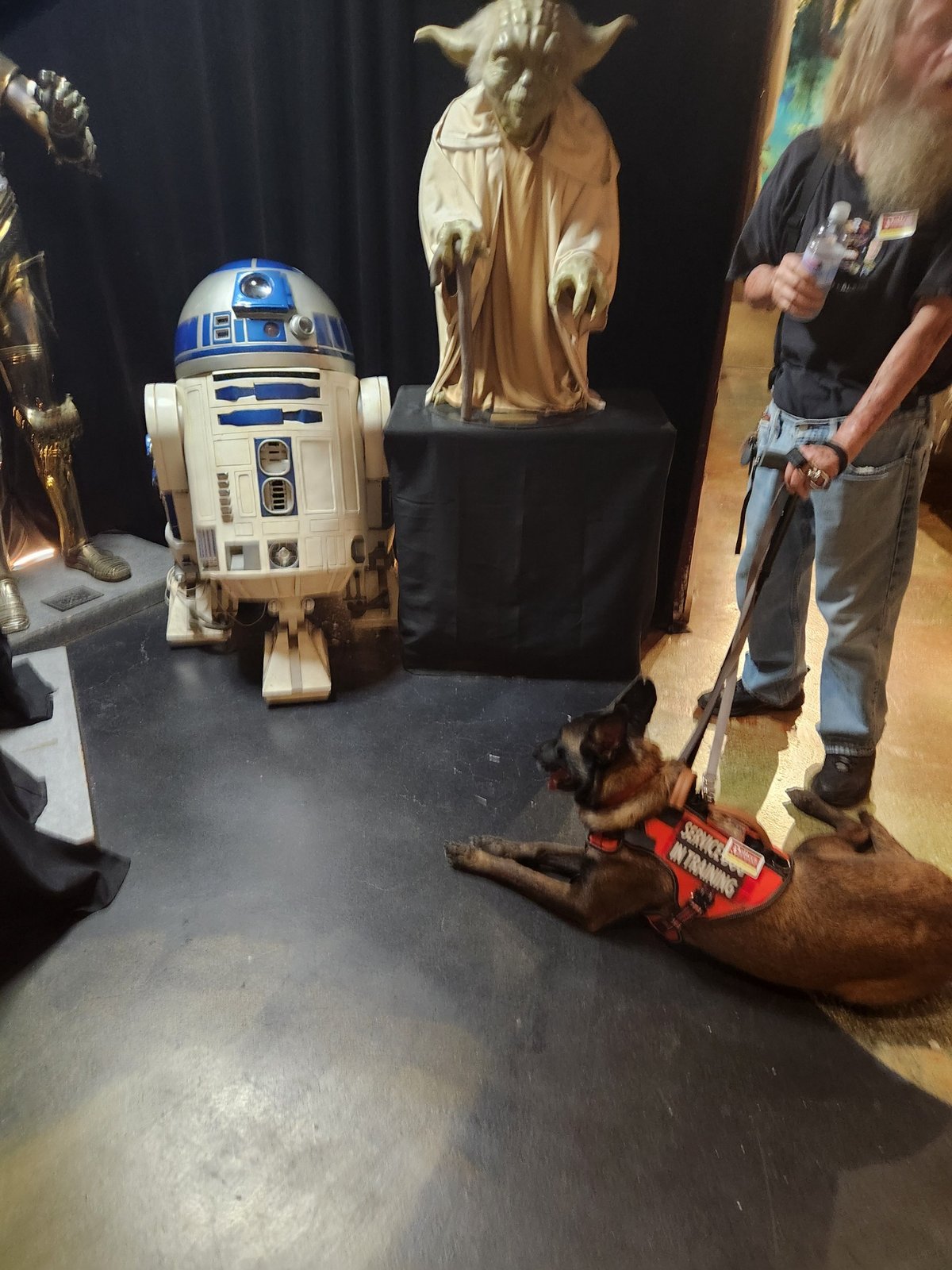
Hotels, Restaurants, and Training Truths
Be sure to read Part 1 and Part 2.1 of this real world service dog training series, if you haven’t already.

Checking In (and Checking Herself)
Check-in at the St. Augustine hotel went smoothly. Lady Priscilla walked in like she belonged there and settled by Dad’s feet in perfect “Relax” mode — her go-to service dog posture when nothing’s actively happening. Head up. Aware. Calm. Ready to alert if needed, but fully grounded in the moment.
We were given a room near the end of the first-floor hallway and a little “Service Dog Inside” hangtag for the door. Thanks to apartment living, she was already an old hand at elevators, heavy doors, cleaning carts — the usual hotel noises that can trip up even experienced dogs. None of it fazed her.
What did catch my attention, though, was the full-length mirror mounted low on the wall — right at eye level. You never know what you’re going to run into with real world service dog training! At this stage, Lady Priscilla was still barky around other dogs, and everything I’d read agreed: dogs do not recognize themselves in mirrors. Most see a stranger and respond accordingly.
I panicked. Started scanning the room for something, anything to cover it.
But she beat me to it.
When I turned around, she was already gazing into the mirror. Calm. Quiet. Curious. She lifted a paw, tilted her head, wriggled her nose. Watched herself move. She didn’t bark. Didn’t bristle. Just looked. It was as if she was seeing herself — really seeing herself — for the very first time. A moment of recognition. Of stillness. Of something more than instinct.

The next morning, we headed to the free breakfast buffet. She stayed close to Dad while he picked his food, then followed him to a table and settled (mostly) beneath it while I got our plates. People noticed her, of course, but no one said a word. She blended into the scene with quiet dignity, as if she’d always been part of it.
But not all dogs were so composed.
Later that day, we stepped outside through the side door near our room. While Dad stood by the ashtray, I took Lady Priscilla around the corner to do her business. Suddenly, Dad came shuffling toward me faster than his back should allow.
“Take a look at that,” he said.
A large, white dog was being dragged through the door, barking and lunging, completely out of control. Its handler could barely manage the leash, and the dog’s behavior made it painfully clear that this was not a trained service animal.
We alerted the front desk.
Apparently, the guests had tried to sneak the dog in through a side door, then claimed it was a service dog when confronted. Later, the woman came to the desk without the dog and offered an awkward apology.
“He doesn’t usually act like that,” she said. “He’s been in the car all day.”
I looked down at Lady Priscilla — perfectly still, perfectly composed.
“Yeah?” I said. “So has she.”
Small win. Big truth. And a testament to how far she had already come in real world service dog training.
Real Restaurants, Real Progress
This was our first trip attempting full sit-down restaurant dining with Lady Priscilla. I would’ve been happy with fast food, but Dad put his foot down. He wanted real food. He was bringing the dog. I could come if I wanted.
He was right, of course. I have a tendency to catastrophize — to imagine everything going wrong before we even begin. But Lady Priscilla didn’t need a warm-up round. She was ready.
Over the course of the trip, we ate at everything from a friendly local diner (where she had plenty of room to settle by the wall) to a tightly packed Italian restaurant where the table legs left hardly any space for a dog. Even there, she worked hard to stay out of the way, tucking herself neatly as close to Dad as possible. She didn’t react when servers reached over her. No popping up or getting underfoot. She just stayed grounded.
We also walked all over downtown St. Augustine. Crosswalks. Cobblestones. Historic buildings and crowds of tourists. She followed our lead with grace and focus — waiting at lights, weaving through foot traffic, and taking everything in stride.

Training in the Real World
It’s important to say this: at the time of the trip, Lady Priscilla had only been in formal training for a couple of months. She was still learning. And like any dog in training, she needed support.
We kept up a light but steady stream of commands and redirection. She didn’t make big mistakes, but she wasn’t perfect either. She barked in obvious frustration at a small dog that bolted out from under a street café table on our way to the beach, yapping furiously at her without warning. Her reaction was big, but it was brief. She reset quickly and kept going.
That’s what matters.
She was still learning to ignore distractions, to default to Relax, to check in with us automatically. And she was trying — every second, every step. That’s the kind of heart she brings to everything. She doesn’t phone it in. She wants to get it right.
If you’re training a service dog, please don’t expect them to be perfect right away. And definitely don’t expect them to match the highlight reels you see online. It takes practice, consistency, and partnership — not just from the dog, but from you, too.
Lady Priscilla thrives on novelty. Where some dogs might be overwhelmed by new places, she finds energy in them. That made this trip not just doable, but transformative. It gave her room to grow, to prove herself, and to build confidence in every new situation.
It wasn’t flawless. But it was real. And it was a major milestone on her journey to becoming the fully trained service dog she’s meant to be.
Curious about what happened at the doctor’s office…or in the cemetery? Read Part 3: Finding Her Footing in a Ghost Town to conclude this series.
Leave a Reply