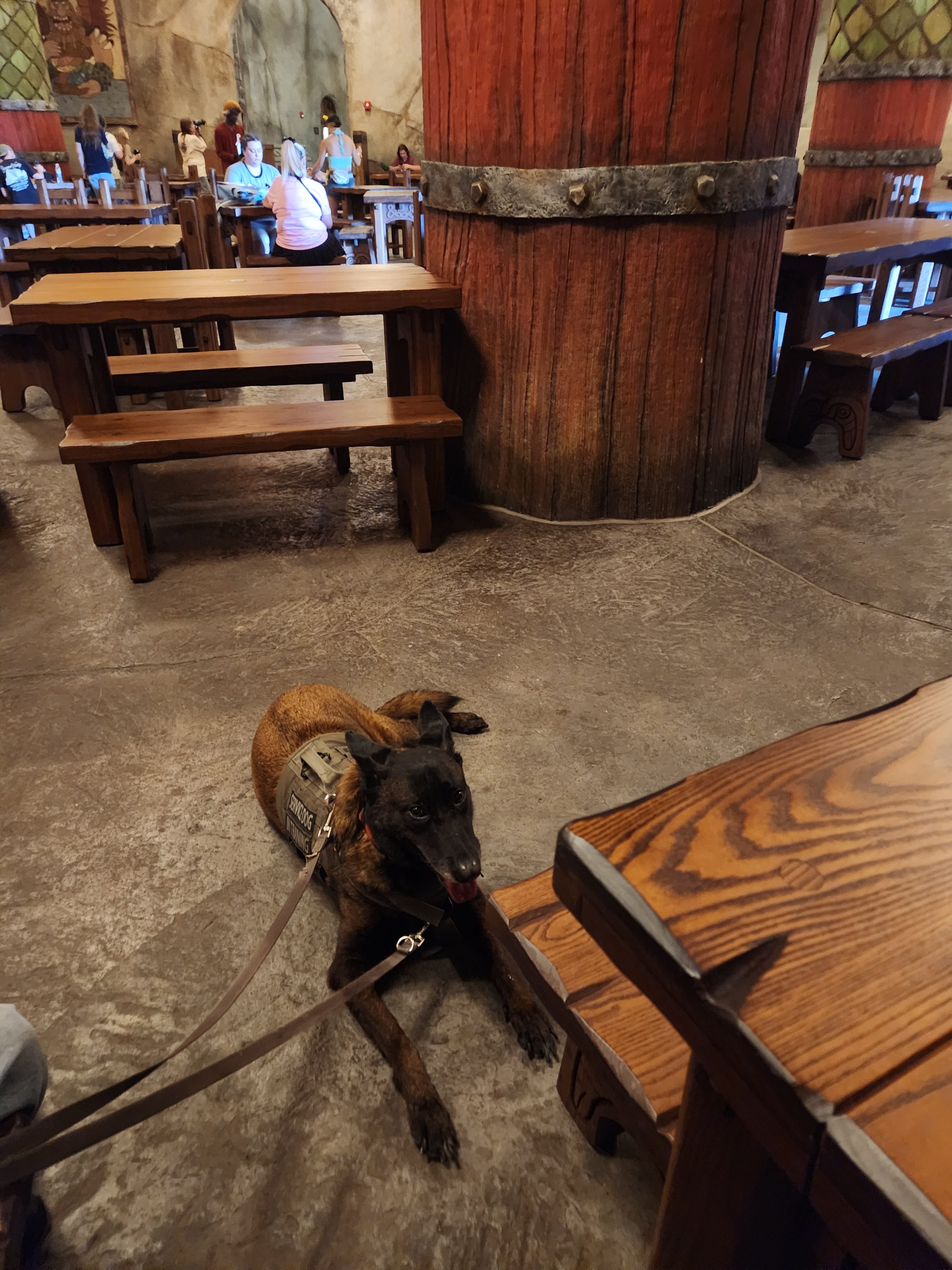
Orlando service dog training isn’t a one-size-fits-all experience — especially if you’re self-training. Every team is different. Every need is different. And no single class or outing can prepare you for the real world all at once. For us, this journey has been about slowly building confidence, emotional regulation, and trust — not just for public access, but for vet visits, sensory surprises, and everything in between.
While I’m not a professional dog trainer, I do hold a bachelor’s degree in psychology and am currently pursuing a master’s in animal science and behavior with a focus on dogs. Over the past year of intensive, structured training, we have developed a science-backed framework known as The Lady Priscilla Method — a trauma-informed, emotionally intelligent approach to raising a reliable service dog through trust, not control. It’s grounded in behavioral science and inspired by our adaptation Maslow’s Hierarchy for Dogs — our way of rethinking what dogs actually need to thrive.
This isn’t a list of best dog trainers or certification programs. It’s a look at the places in and around Orlando that helped us practice key skills, build confidence, and grow together as a team.
It’s also worth noting that Florida grants full public access rights to service dogs in training, but not all states do. Under the Americans with Disabilities Act, those rights apply only to fully trained service dogs. If your state doesn’t grant broader access, you’ll need to keep training sessions limited to dog-friendly public spaces.
Real-World Outings for Orlando Service Dog Training Public Access
One of the most important parts of Orlando service dog training is learning how to navigate the real world — not just structured classes. Theme parks, restaurants, stores, hotels, and even sidewalks offer unpredictable distractions that no obedience drill can fully simulate. Practicing in these spaces helped Lady Priscilla learn to stay calm, focused, and confident, no matter what was happening around her.
We’ve worked hard to make public access outings a normal part of our training routine. Over the past year, we’ve trained in elevators and hotel lobbies, waited patiently in checkout lines, and even navigated crowded exhibits at museums and attractions. In each case, the goal wasn’t perfection — it was emotional regulation, situational awareness, and trust.

Some of our most useful outings include:
- Titanic: The Artifact Exhibition. A calm, low-sensory museum that was ideal for early public access practice.
- The Accidental Curriculum. A vivid lesson in managing real-world stimuli, from Ikea chaos to dimly lit wax museums.
- Purposeful trips to local spots like Bass Pro, Publix, and CVS — each one turned routine errands into essential public access labs.
Want a deeper look at what goes into real-world readiness? Here’s how we approached the service dog public access test — and why we chose a different path.
CGC Prep That Was Worth the Drive
There are plenty of places in Orlando that offer Canine Good Citizen (CGC) prep classes — from pet stores to private trainers. But when it came time for Lady Priscilla, we wanted something more than a checklist of obedience cues. For structured training, we needed an expert whose approach aligned with our own.

That’s what drew us to Jenny at P.U.P.S. in Gainesville. She isn’t just a certified behavior consultant. She also spent two years working in the canine cognition lab at the University of Florida. Her cognitive-behavioral approach to training mirrored the way we were already thinking about the Lady Priscilla Method. She knew how to shape emotional regulation, strengthen communication, and help dogs learn how to think through challenges.
So we made the two-hour drive each week, and it was worth every mile. The CGC class became more than just practice for a test. It was a laboratory for learning — a chance to work through dog-to-dog greetings under pressure, test focus in distracting settings, and build confidence in novel situations. That structured environment gave us the accountability and consistency we couldn’t replicate on our own.
The Messy Middle
The journey wasn’t always smooth — we had our messy middle moments, awkward passes, and big wins along the way. But each week, Lady Priscilla showed us more of what she was capable of. By the time test day arrived, she had transformed from “maybe ready” to steady and focused.
If you’re curious about what CGC training looks like in practice, here are some moments from our journey:
- Dog Grad School. How the class was structured, and why we made the drive
- Putting the Lady Priscilla Method to the Test: CGC Results. The official test day.
- The Dog Who Booped Her Seatbelt — our first step into CGC Advanced
For us, CGC prep wasn’t about the ribbon. It was about trust, teamwork, and proving to ourselves that we were ready for bigger challenges ahead.
Agility and Confidence-Building at Zoom Room

Not all service dog training happens in quiet classrooms or on neighborhood walks. Sometimes the best skills come from surprising places — like the agility course at Zoom Room Winter Park. While agility might look like it’s all about speed and tricks, for us it became a way to build Lady Priscilla’s confidence, body awareness, and focus under pressure.
Every obstacle was a new lesson. Weaving between poles required concentration, balancing on narrow planks demanded trust. Climbing the A-frame helped her learn to commit to a task even when she couldn’t see the other side. These challenges strengthened her coordination and sharpened her ability to tune in to us, even when the environment was loud and distracting.
We also found that occasional private lessons at Zoom Room gave us the space to target specific needs. From finally nailing the tunnel to rehearsing her people manners, those one-on-one sessions helped translate the agility course lessons into everyday public access skills.
Agility didn’t just make Lady Priscilla more athletic — it made her more adaptable. And that adaptability carries over into crowded stores, noisy sidewalks, and anywhere service dogs are expected to stay steady in the face of the unexpected. What was unexpected to us, though, was how easily she picked up her Trick Dog Novice title along the way.
Private Lessons for the Unusual Challenges

Some challenges don’t come up in group classes — and that’s where private lessons can make all the difference. We’ve been incredibly fortunate to work one-on-one with Emily at PetSmart South Orlando since just a month after bringing Lady Priscilla home. She’s the one we turn to for the “weird stuff.” Unusual textures, novel scenarios, and calm handling in situations that don’t appear on any standard training checklist. Those sessions give us the flexibility to problem-solve creatively and focus on Lady Priscilla’s individual needs in ways group classes never could.
Emily isn’t at PetSmart or taking new clients anymore, but we still work with her privately and are grateful to have her as part of our team. The good news is that PetSmart South Orlando now has a new trainer, Jackson, who also offers private lessons. We can’t vouch for him personally, but after a year and a half of weekly sessions, we got to know nearly everyone at that store. We genuinely like and trust the whole team. If you’re training a service dog in Orlando and looking for flexible support that classes don’t quite hit, Jackson could be worth a try.
Vet Care as Orlando-Area Service Dog Training

For many dogs, the vet’s office is the scariest place in the world. For Lady Priscilla, those early visits were overwhelming — and honestly, finding the right vet was a journey of its own. We eventually landed at Shaffer Animal Hospital in Oviedo, and the difference has been night and day.
Shaffer is fully committed to the Fear Free Certified® model, not just in name but in practice. Every veterinarian, tech, and staff member at the clinic is officially certified through the American Animal Hospital Association’s Fear Free program. Some, like our cooperative care groomer, even hold multiple certifications (both veterinary technician and trainer). That matters, because “fear free” has become something of a buzzword. Many clinics use the phrase, but unless the staff are actually certified, the approach can vary widely. If you’re looking for a Fear Free practice, it’s worth checking the official Fear Free directory to be sure.
At Shaffer, vet care is part of Lady Priscilla’s training. Every nail trim, ear check, and weigh-in is also a chance to practice cooperative care — staying calm, offering consent behaviors, and building trust that handling doesn’t have to hurt. Instead of white knuckling through exams, she’s learning to be a willing participant in her own care.
Shaffer is also connected with G.O. D.O.G.S, their training facility next door. G.O. D.O.G.S runs a variety of classes, including CGC prep, though their schedule didn’t align with ours.
For us, having a veterinary partner who truly understands behavioral health has been just as important as any class or outing. Vet visits aren’t just appointments — they’re training opportunities in emotional regulation and trust.
Emotional Readiness Comes First

The most important lesson we’ve learned in training Lady Priscilla is that emotional readiness always comes before skills practice. A dog can’t succeed at public access, vet care, or even basic obedience if she doesn’t feel safe. For us, that sometimes means pausing classes, skipping outings, or stepping back from structured training in favor of quiet recovery time.
This is the heart of The Lady Priscilla Method: trust before control, emotional stability before checklists. By respecting where Lady Priscilla is on any given day, we build a foundation of resilience that makes every future challenge easier to face. Emotional readiness isn’t just important for us here in Orlando — it’s one of the four pillars of service dog training.
Orlando gives us plenty of places to practice, but those only work when she is ready to engage. The same environments that become confidence-builders would be overwhelming if we pushed too soon.
If you’d like to see how this principle shows up in different parts of our journey, here are a couple of examples:
- Extraordinary Minds — how brilliance can hide in the most unlikely places, from an abused child to a discarded dog
- Not a Paw Out of Place — how emotional regulation shapes a practice CGC run
At the end of the day, success isn’t about how fast a dog passes a test. It’s about creating a safe, trusting partnership that can weather whatever surprises the world throws your way.
How We Tie It All Together
Looking back, Orlando service dog training has given us a landscape as varied as the city itself: theme parks and hotel lobbies, group classes and private lessons, cooperative vet visits and agility courses. Each place teaches something different — but what ties it all together is the same framework we started with: trust before control, readiness before checklists, and steady practice that builds real-world confidence over time.
No single class, trainer, or outing makes Lady Priscilla who she is. But together, these experiences give us the foundation to keep moving forward — toward advanced titles, new adventures, and a service partnership that’s still growing every day.
If you’re on your own self-training journey in Orlando (or anywhere), I hope our story shows that it’s possible to weave together resources, outings, and professional support into something cohesive. Service dog training isn’t about rushing to the finish line. It’s about creating a partnership that works now — and keeps working as the challenges get bigger.
Case Study: Lady Priscilla Takes on HHN 2025

If you’re in the Central Florida area, you already know that Halloween Horror Nights at Universal Orlando is synonymous with sensory overload… and that’s just for humans. Now think of it from a dog’s perspective. Here’s what happened when a year of careful preparation came together.
Optional Next Steps
If you’ve made it this far, you’re already doing the most important part — paying attention to what your dog needs and thinking critically about how to support them. That’s the foundation of service dog training in any city, and it matters more than any single class or outing.
If you’d like a little more structure, I’ve put together some printable resources in the Lady Priscilla Method Etsy shop. They’re designed to complement the same trust-based, trauma-informed approach you’ve been reading about here. No pressure — just tools that I wish I’d had when we were first starting out.
Leave a Reply