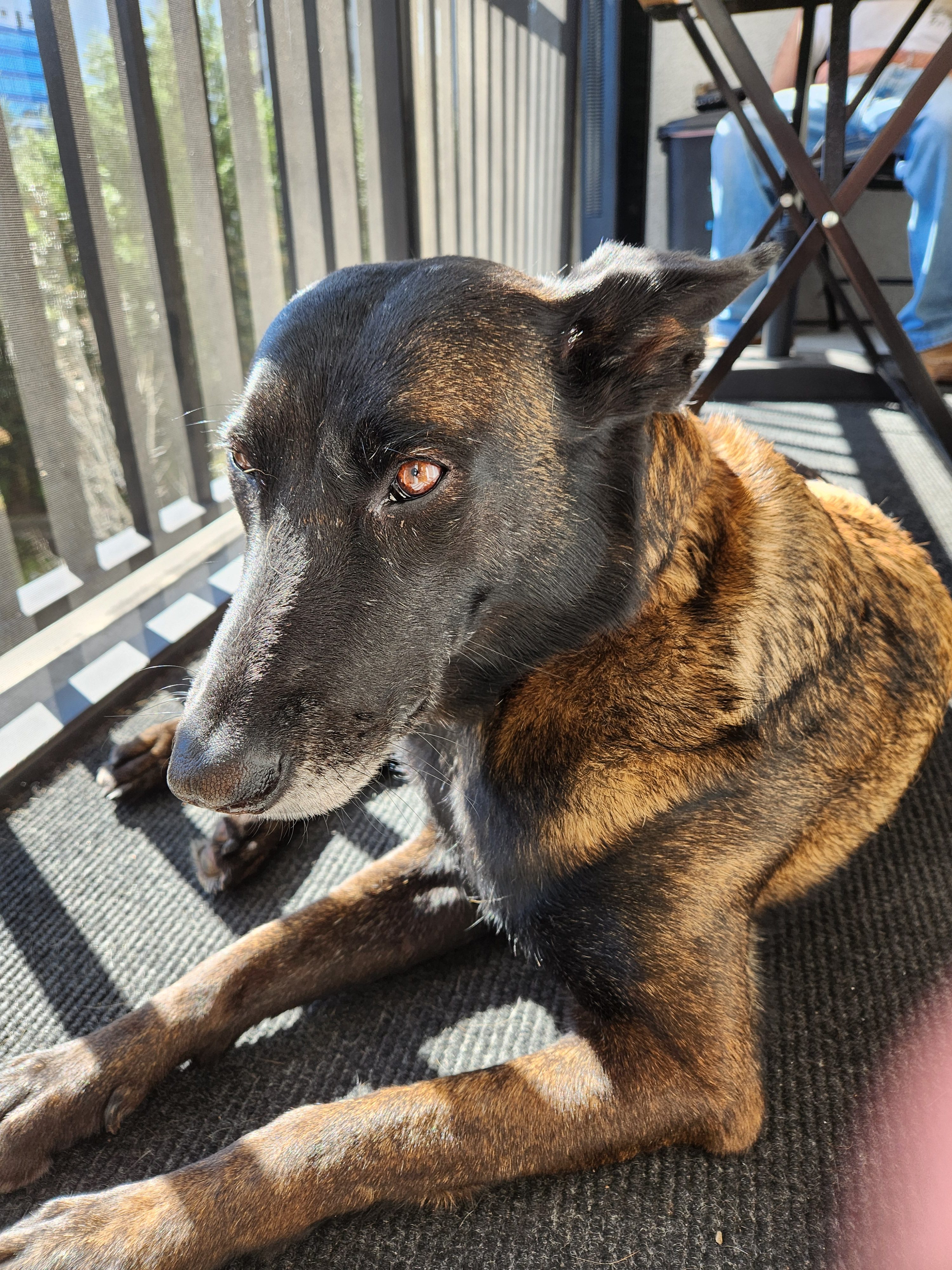
People often ask, “How do dogs show affection?” The answers are as varied as the dogs themselves. Some lean. Some lick. Some follow you from room to room.
In our home? My dog hugs me.
Most people will tell you dogs don’t like hugs. Especially not dogs with trauma histories. Hugs, after all, mimic restraint — wrapping around the body, limiting movement, closing off escape routes. For many dogs, especially those with reasons to fear being cornered or confined, it’s too much.
In the beginning, Lady Priscilla agreed.
Touch was tolerated, not invited. She stayed close, but not too close. Even affection had boundaries.
But now? Now not only is she a dog who loves hugs, but she actively asks for them.
Multiple times a day, she approaches while I’m seated on the couch… after spending some time resting on the floor, watching the room, watching me. Then slowly, deliberately, she buries her face deep into my lap. Not with urgency. Not with anxiety. But with intention. She leans in, softly at first, then with her full weight. I pet her with both hands, long strokes down her sides. And then, almost automatically, my arms wrap around her.
And we just stay.
Not because she’s scared.
Not because she needs anything.
But because she understands what this means — and she wants to experience it with every fiber of her being.
She doesn’t sit in my lap. Instead, she becomes it.
She melts into love she chose.
How Do Dogs Show Affection?
Dogs show affection in all kinds of ways — some obvious, some subtle. A wagging tail, a nudge with the nose, choosing to rest at your feet. For dogs with clean emotional slates, those signs often come naturally.
But for dogs with trauma? Affection can take time. It has to be built — not just felt.
In Lady Priscilla’s case, the affection didn’t come in the form of kisses or bouncing excitement. It came in the form of quiet proximity. Then gentle leaning. Then full-body stillness wrapped in trust. And eventually… hugs.
This kind of trust-based affection is what we describe in our Cognition–Emotion–Behavior triangle — a visual model that shows how emotional safety leads to confident behavior, and how thoughtful choices like this emerge from real relationship, not training alone. Or, for a more scientific deep dive, take a look at our Maslow-CBT Pyramid.
How Did We Get Here?
This moment didn’t come out of nowhere. It’s the product of everything that came before — a quiet culmination of trust built through everyday choices, gentle habits, and hard-won victories.
The journey from “don’t touch me” to “my dog hugs me” started after we finally found the right vet — something we’d fought hard for.
The long and teary road to that match is a story we’ve told before, right here.
What matters now is what happened after. Once we had a Fear Free clinic, compassionate staff, and a provider who understood trauma recovery, the emotional healing could truly begin.
We started bringing Lady Priscilla in for short, no-pressure visits — just walking into the building, saying hi to the front desk, and leaving. Then eventually stepping onto the scale. Sitting quietly in the exam room. Nothing invasive. Nothing scary.
And even so, she wasn’t ready for touch.
Not from the techs.
Definitely not from the vet.
She would stand nearby, calm but cautious, watching every move. If someone reached toward her, she’d gently back away. It wasn’t fear in the traditional sense — it was more like thoughtful distance. A soft “not yet” in the shape of her body.
Still, she kept showing up. And so did we.
But one day, the vet made a decision.
She calmly, kindly… just went for it.
There was a brief, silly chase around the exam room — a few laps, a few dodges — and then the vet caught her. Held her. Touched her.
And Lady Priscilla… stopped.
No panic, protest, or drama.
She just accepted it.
Okay, she said. I guess I really am safe here.
From that moment forward, the progress was rapid. Her trust had finally crossed a threshold.
What It Means When My Dog Hugs Me
Emily the Dog Whisperer
Around the same time, we began private, off-leash training sessions with Emily at PetSmart— a kind, soft-spoken trainer who meets dogs where they are. She watches. Listens. Tunes into who your dog is and what they need to thrive. You can read about those early training days here.
With Lady Priscilla, that meant slow, quiet sessions focused on gentle engagement and emotional trust. One of Emily’s go-to tools was soft petting — introducing it not as a distraction or reward, but as part of the rhythm of connection. Lady Priscilla learned that touch wasn’t something to endure. It was something to lean into.
And lean she did.
How do dogs show affection? Sometimes nothing beats a full body hug.
She doesn’t ask for hugs because she needs reassurance.
She asks for them because she’s seen what they mean.
Maybe it’s from watching me hug my dad. Perhaps it’s from Emily’s hands on her back. Maybe it’s just a thing she taught herself — like everything else she’s done.
But somewhere along the way, she decided that this is what love looks like.
And now, she wants to feel it. Deeply. Completely. On her own terms.
A Final Note
She used to flinch from touch.
Now she presses her nose into my lap and stays.
She doesn’t need hugs to feel safe anymore.
People sometimes wonder, why does my dog hug me? For Lady Priscilla, it’s not about fear or need. It’s about choice.
She’s a dog who loves hugs because she knows what they mean.
And if you’re wondering how we made our way from shutdown and fear to full-body affection — it wasn’t luck. It was trust, built slowly through the principles of The Lady Priscilla Method. It was training, shaped by her journey toward CGC. And it was a whole lot of love.
This isn’t a story about obedience.
It’s a story about becoming.
And she’s not done yet.
Leave a Reply