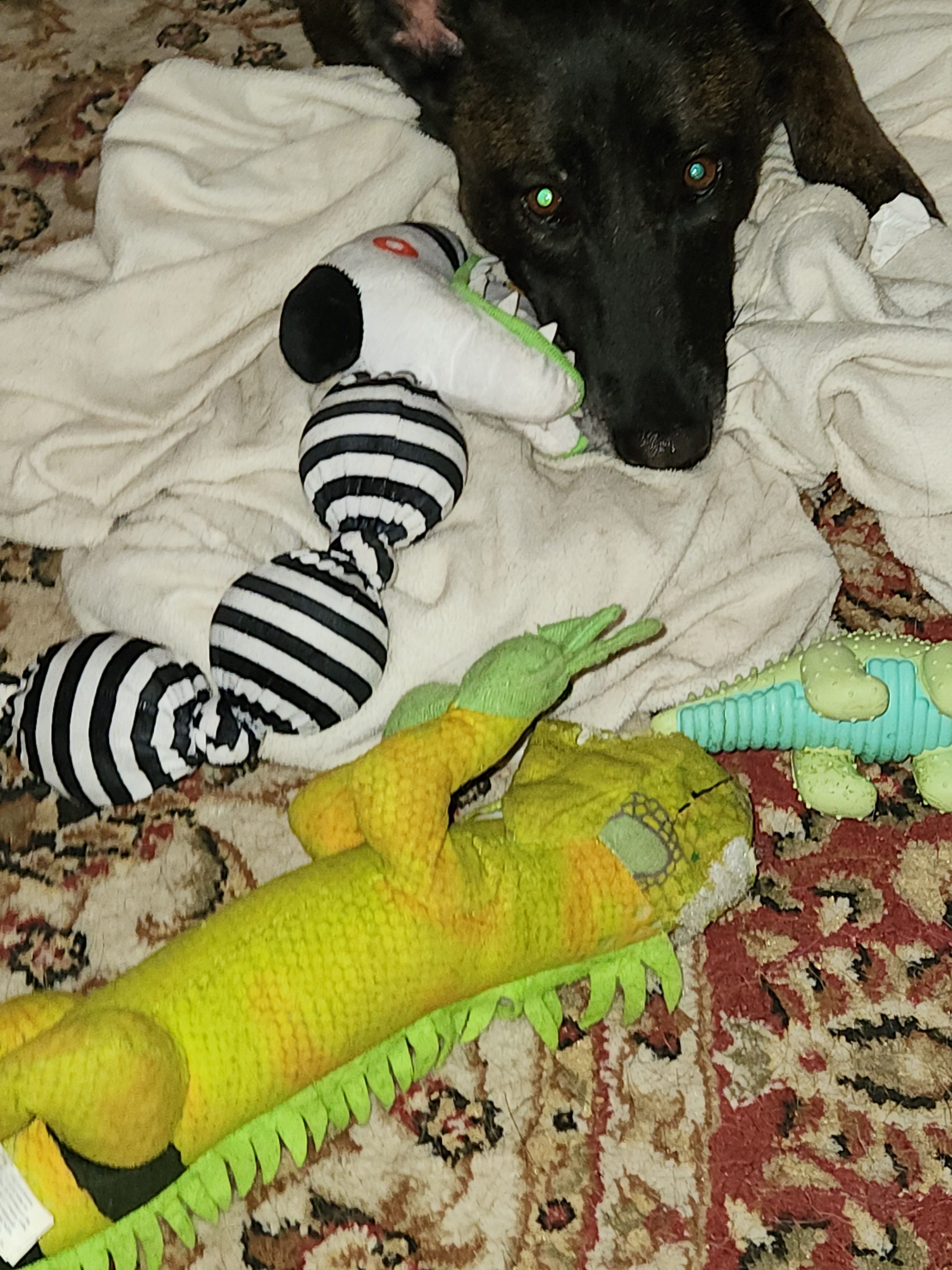
Some dogs grow up too fast. But what if they get a second chance to grow up again—this time with joy? A happy puppyhood for rescue dogs is possible, even when they’re already grown.
Lady Priscilla didn’t come to us as a floppy-eared baby with a waggy tail and a teething ring. She was two years old when we brought her home. Old enough to have been abused. Bred. Abandoned. Old enough to have been through things that made her flinch at kindness and get confused by touch. And somehow, through it all, she was still waiting for something — something she’d never been allowed to have.
She didn’t know how to play. She didn’t know how to be petted. She didn’t chew toys, didn’t zoom, didn’t even bark. In those early days, she lay in her crate like a ghost, silent and still, as if trying not to take up space.
But here’s the thing: Puppyhood isn’t just a stage. It’s a state. A sense of safety, trust, curiosity, and freedom. And as it turns out, it’s never too late.
I learned that from my dad.
He had a rough childhood, too — one that left scars. But by the time I came into the world, things had started to change. There was laughter. Road trips, late-night Dungeons & Dragons games, drum kits, theater. For his birthday one year, my mom and I made him a fire-engine red T-shirt with puffy paint in every color. In giant block letters — complete with a backwards R — it read:
It’s Never Too Late to Have a Happy Childhood.
It became a kind of family motto.
And now, decades later, we’re watching it come true again… this time on four paws.
Relearning Touch
It took weeks before Lady Priscilla could tolerate being touched outside her crate. Petting wasn’t comforting to her — it was confusing. Unfamiliar. So our trainer Emily spent two sessions a week for months gently showing her what affection could feel like. First just a few fingers on her side, light as air. Then gradually building up.
Now? They boop noses. They share full-body hugs. They’ve built a language of softness that would have once sent her running.
Joy in Motion
The first time we took her to a Sniffspot and removed the harness, she just stood there. She sniffed. Took a few tentative steps. And then, all at once, she broke into a wild run — legs flying in every direction like a baby deer discovering her limbs for the first time.
She’s graceful now. Swift as a gazelle. She can dart past a table leg at full speed or slide to a perfect sit right in front of it. But I’ll never forget that first chaotic gallop. The one that said: I’m free.
She had to learn the stairs, too. The first time she tried, she frog-hopped like she couldn’t make sense of the pattern. Now she walks them slowly in sync with my dad’s cane — one step at a time — or backs down them to make room for people coming through.
And one fall afternoon, she stood at the edge of a leaf-covered park, paw hovering uncertainly over the crunchy ground. With coaxing, she stepped forward… and then she lit up. Smiling, bounding, kicking up leaves in every direction. From that moment on, she became fascinated with the world beneath her paws… especially gravel.
Zoomies and Caution
Even her zoomies had a learning curve.
Early on, she’d do tiny head shakes or air snaps when she needed to potty — like controlled micro-zoomies. Then came the day we exited the elevator after a walk and she did two little bounce-bounces, looked at me like “Was that okay?”… then quickly recomposed herself and walked home.
A few weeks later, she was zooming in open fields on leash, bucking and bouncing with joy. And one day — just once — she did a full room-to-room zoomie at home. Slipped on her Place mat, crashed into a glass-front cabinet, and bruised her paw. No lasting damage. But after that, she started to moderate herself. Now when she’s feeling frisky, she grabs a chew toy, rears up playfully at her harness, or zooms for snacks instead. It’s all part of the regulation skills we built over time. Five Feet, Four Dogs, One Big Win shows how far she’s come in staying calm under pressure.
That’s joy with wisdom. Freedom with self-trust.
Bedtime, Reimagined
Her crate was her refuge early on. The only place she felt safe. But when she started spending more time with us, we built a bedtime ritual that remains nearly unchanged to this day.
It starts with a snack lure to guide her to bed — sometimes two or three before she’ll accept. She’s recently added physical cues: a playful rock back and forth, or going completely limp until we gently nudge her with a pat on the butt. Once inside, she eats while I pet her and talk softly. Then comes water. More petting. Eventually she lays down.
That’s when Dad arrives. He shushes her to sleep with soft murmurs like “go off to puppy dog dreamland,” laced with quiet shhhhs. He stays until she’s asleep.
Early on, she didn’t know what to do with stuffed animals. But a few weeks into this ritual, she started cuddling with them. Sometimes she still does.
She became someone who could be comforted.
(We talked more about those early fearful days in From Frozen to Free.)
The Puppyhood She Earned
People talk about socializing puppies during their critical window. About how you only get so much time. But dogs like Lady Priscilla remind us that growth doesn’t come with an expiration date. That healing isn’t linear, and joy doesn’t care how old you are.
She didn’t grow up with us.
She grew backward, into someone soft and joyful and brave.
She learned to be petted.
She learned to play.
She learned to zoom, and giggle, and hold still while someone whispered love into her ear as she fell asleep.
Because it’s true — the shirt said it best:
It’s never too late to have a happy childhood.
Even if you’re two years old and born with four legs.
This journey is what gave rise to The Lady Priscilla Method, a training philosophy rooted in joy, curiosity, and second chances that all starts with building a happy puppyhood for rescue dogs, regardless of age.
Leave a Reply